A lighthouse road trip sounds straightforward: pick a stretch of coast, point the car at it and stop whenever a tower appears on the horizon. In practice, the difference between a frustrating day and a memorable one comes down to three things — how far you are genuinely driving, what the tide and the weather are doing, and whether you can legitimately reach the headland you had in mind. Get those right and the rest looks after itself.
Three bodies look after lighthouses in these islands: Trinity House for England, Wales and the Channel Islands, the Northern Lighthouse Board for Scotland and the Isle of Man, and Irish Lights for the island of Ireland. Their websites are the sensible starting point for checking which towers still operate, which are open to visitors, and which are simply landmarks to admire from a distance.
Start with the lighthouses, not the map
It is tempting to draw a line around an entire coastline. Resist it. A satisfying trip usually covers four to six lights within one manageable region: the north Cornwall coast between Trevose Head and Pendeen, say, or the Firth of Forth and the East Neuk, or the Pembrokeshire coast from Strumble Head round to St Ann's Head.
Then check each one on its own. Many lighthouses are automated, unmanned and closed to the public. Others have seasonal visitor centres, occasional open days run by local trusts, or a keeper's cottage that has been converted into self-catering accommodation. A tower that was open last summer may be shut this year for maintenance, so treat any listing older than a few months with suspicion and confirm before you commit a day to it.
Note also where the light sits. Some stand at the end of a private lane, inside a working harbour, on a nature reserve or on Ministry of Defence land. That does not rule them out, but it does change how you plan the approach.
Build a route you can actually drive
Coastal maps flatten distance. A headland that looks like twenty minutes from the last one can take an hour once you are on a lane that twists through three villages with a tractor in front of you.
Distances lie on the coast
Plan on roughly half the speed you would manage on a main road, and build in slack. Two lighthouses in a morning and two in an afternoon is a realistic pace if you want to walk out to any of them. Six in a day is a box-ticking exercise with no time to look at the sea.
Single-track roads, ferries and fuel
In rural Scotland, west Wales and parts of the south-west you will meet single-track roads with passing places. Pull into the one on your left to let oncoming traffic through, and do not park in them — they are the road's only overtaking and passing space. If a ferry is involved, check the timetable and book ahead in summer; the last sailing of the day is not a deadline you want to be testing. Fill the tank when you see a filling station, not when the gauge suggests you should.
Tides, weather and daylight
These three decide whether a lighthouse visit is a pleasant hour or a wasted afternoon, and none of them can be fixed on the day.
Read the tide table first
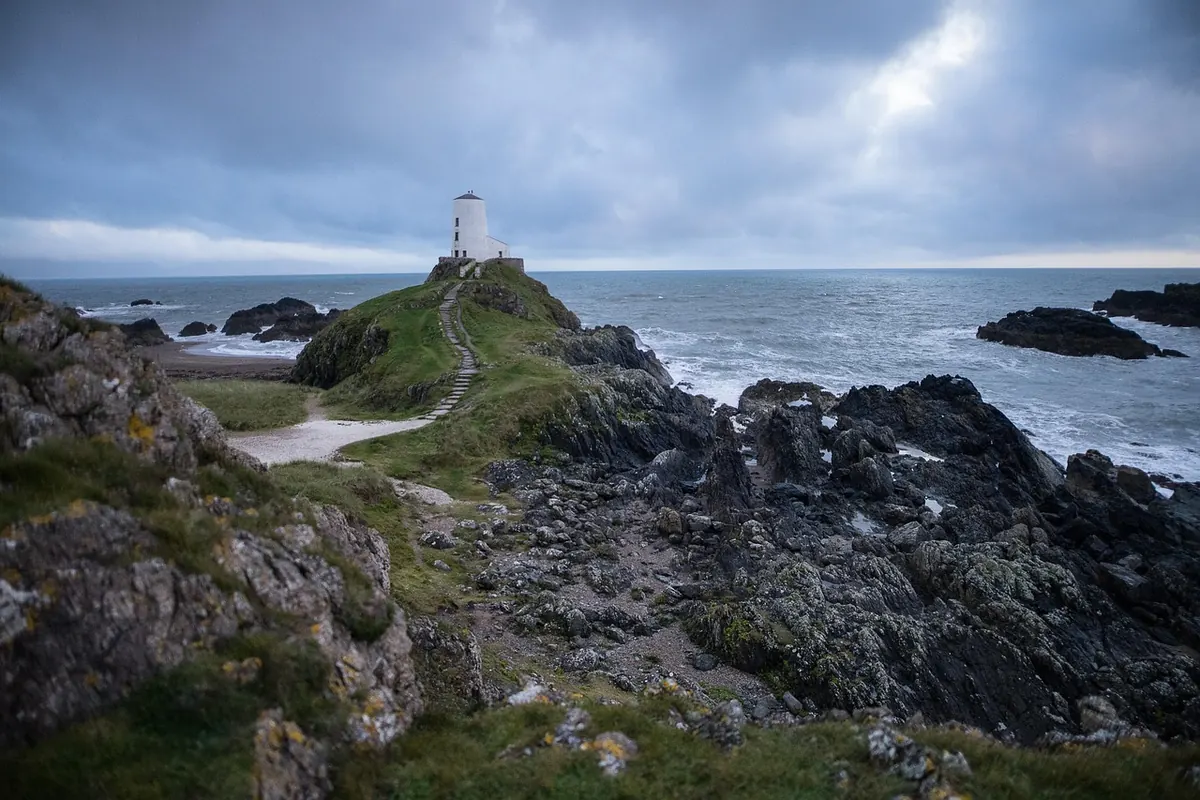
Several of the best approaches involve a causeway, a beach or a tidal spit. Local harbour authorities and the coastguard publish tide tables, and where a causeway is genuinely dangerous the safe crossing times are usually published too. Plan walks to fall either side of low water rather than around it, and remember that a rising tide cuts off the route behind you long before it reaches your feet. Check tide times against the day you are actually travelling, not the day you booked.
Weather and light
A Met Office coastal forecast is more useful than a general one, because wind matters as much as rain: a headland in a stiff south-westerly is unpleasant even in sunshine. Sea mist can swallow a tower entirely. Daylight is the other constraint. In midwinter, northern Scotland offers only a short window of usable light, so plan fewer stops and start early. In high summer, the far north barely goes dark — excellent for late photography, but tiring if you have a long drive home.
Access, permissions and staying out of trouble
Most lighthouse trips involve land that belongs to someone else. A few minutes of checking saves an awkward conversation:
- Know your rights. In Scotland, statutory access rights cover most land and inland water, provided you behave responsibly. In England and Wales, stick to public rights of way, permissive paths and the England Coast Path.
- Check for closures. Firing ranges, nature reserves and cliff paths can be shut at short notice, sometimes for nesting seabirds or for safety after erosion.
- Ask, if it is unclear. A knock at a farmhouse door or a word with a harbour office often turns a locked gate into a friendly wave.
- Leave gates as you find them, keep dogs under control near livestock, and never park in a field entrance or blocking a passing place.
- Think before flying a drone. CAA rules apply everywhere, and many sites discourage or prohibit drone use. If in doubt, leave it in the car.
Take particular care on wet rock and at the base of cliffs. Waves arrive in sets, and the seventh is often the one that reaches you.
Planning your photography stops
East-facing towers catch the sun at sunrise; west-facing ones reward you at sunset. Work out which way each light faces before you decide the order of the day, rather than arriving at the wrong hour and shooting into the glare.
At night, the beam is the picture. Lights flash in set patterns, so watch a full cycle before you start, then time your exposures to catch the flash rather than guessing. A tripod is essential, and a lens cloth earns its place against salt spray. Carry a torch — ideally with a red setting so you keep your night vision — and tell someone where you are walking if you are heading out on cliffs after dark.
The pre-trip checklist
- Confirm which lighthouses are open, and on which days.
- Note tide times and any safe crossing windows.
- Check the coastal forecast and sunset time for each day.
- Save offline maps — signal vanishes on many headlands.
- Pack boots, waterproofs, a torch, water and something warm.
- Charge camera batteries and clear the memory card.
- Tell someone your route and expected return time.
Make it a slow trip
The best moments on a lighthouse trip are rarely the ones you planned. They are the ten minutes spent watching a seal, the tea stop in a village you had never heard of, the decision to skip the last tower because the light on the water was too good to leave. Build slack into every day, accept that you will not see them all, and you will come home with far more than a set of photographs.
Photo: tookapic / Pixabay