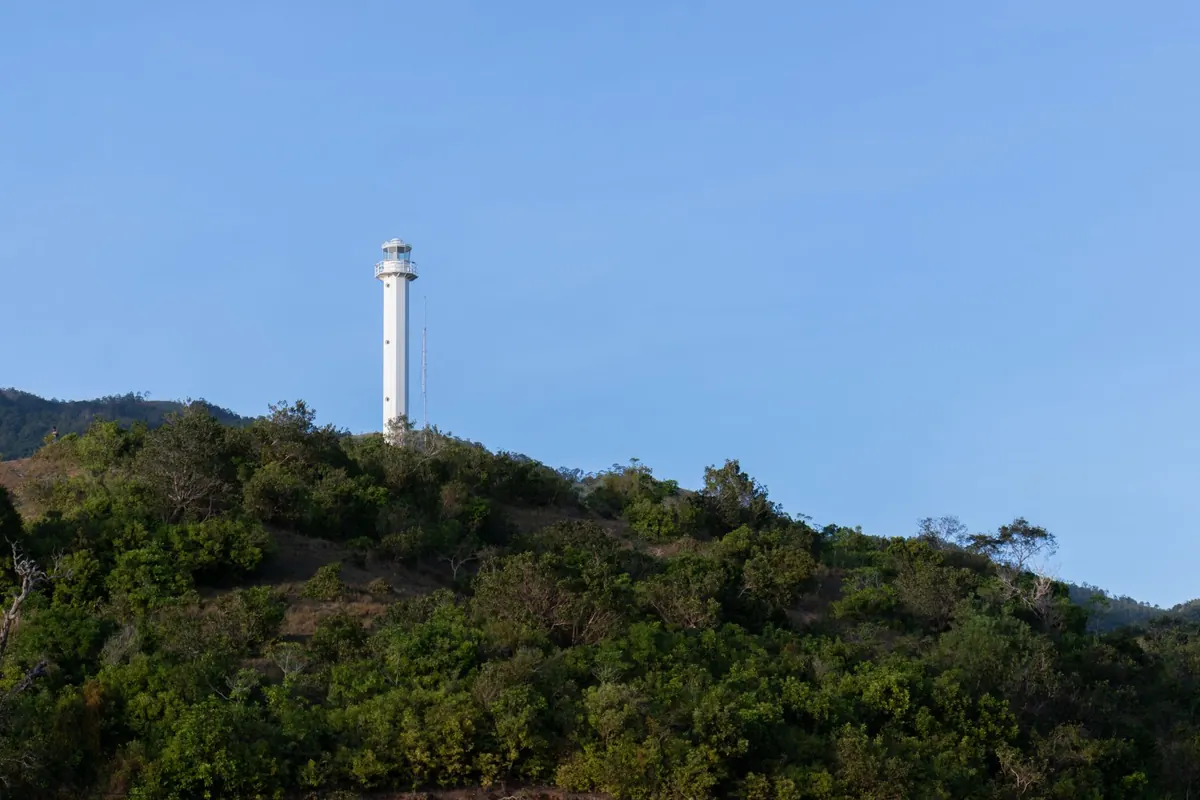
Put a fire on a hilltop and somebody on the next hilltop will see it. That is the whole principle behind Britain's beacon chains, and it is why they have been lit for warning, defence and celebration for the better part of five centuries. The same ridges that carried news of the Spanish Armada in 1588 carried news of the Silver Jubilee in 1977 and of the Coronation in 2023. The purpose changed. The geography never did.
How a beacon chain actually worked
A beacon site was chosen for one quality above all others: line of sight. From one summit you could see the next, which on low ground might be only a few miles away and on a long ridge considerably further. Each station had a fire basket, often an iron cresset or a cage of iron bars, set on a stone or timber platform, sometimes beside a small shelter where the watchmen waited with the fuel.
The fuel was anything that burned hot and fast: pitch, tar, resin, dry furze, faggots of wood. Parishes were expected to keep the platform sound and the fuel dry, and men were paid to keep watch on the nights that mattered. On a clear night a chain could pass a warning far faster than any rider on the worst roads in England.
The catch was that a beacon carried exactly one message. Every light in the chain said the same thing: something is happening on this coast. It could not say how many ships, how many men, or which way they were heading. False alarms were frequent, and a beacon lit too early could send a county's militia marching through the night for nothing.
1588: the Armada summer
By the 1580s England had a coastal warning system in a state of readiness, with beacons surveyed, listed and repaired along the south and east coasts. Invasion scares had been running for years, so when the Armada was sighted off the Lizard in July 1588 the machinery was already in place.
Fires went up along the Cornish and Devon coast, then inland, hill by hill. Macaulay's poem fixed the image in the national memory for good. What the beacons achieved was not tactical but organisational: they emptied villages into the roads, brought the trained bands to their mustering points and turned a sea battle off Plymouth into a national emergency.
What the beacons did, and what they could not do
They warned. They did not command. Orders, letters and dispatches still travelled by rider, and the decisions that mattered were taken by men who had been given their instructions weeks earlier. The beacons bought time, and in 1588 time was the whole game.
Between the wars: from fires to shutters
Beacons were kept in reasonable repair through the seventeenth century, then decayed as the memory of invasion faded. They were revived sharply in the 1790s, when Revolutionary France made the south coast feel like a frontier again. Coastal beacons were prepared, Martello towers went up, and a new device appeared alongside them.
The Admiralty's shutter telegraph, first laid out from London towards the coast in the 1790s and followed by semaphore lines, could send actual words rather than a single alarm. It needed daylight, a clear line of sight and a trained man at every station. Beacons were cruder, cheaper, and they worked in the dark. For a generation the two systems overlapped; by the middle of the nineteenth century the electric telegraph had made both obsolete for warning purposes.
What survived was the custom. A hill that had carried a warning fire for two hundred years made an obvious place for a commemorative one.
From warning to celebration
Victoria's Diamond Jubilee in 1897 put bonfires and beacons back on hills across Britain. The habit stuck, and the twentieth century turned the chain inside out: a warning you hoped never to see became a fire you very much hoped people would.
- 1897 — Victoria's Diamond Jubilee, with beacons and bonfires on high ground across the country.
- 1977 — the Silver Jubilee, when a formal chain of beacons was lit from landmark sites nationwide.
- 1988 — the four-hundredth anniversary of the Armada, which returned beacons to some of the original headlands and cliffs.
- 2002 and 2012 — the Golden and Diamond Jubilees, each with beacons in the UK, the overseas territories and across the Commonwealth.
- 2022 and 2023 — the Platinum Jubilee and the Coronation, lit to a fixed timetable so the chain read across the map as one event.
- 2025 — the eightieth anniversary of VE Day brought another round of beacons, often lit from the same hills as 1588.
Modern beacons are usually gas-fuelled baskets on a trailer, which removes most of the smoke and none of the spectacle. What matters is the timing. A national chain lights at a set moment, because the point is not the individual fire but the line of them.
Reading the chain in the landscape today
The sites are still there, and many are easy to find once you know what you are looking for.
- The name on the map. Beacon Hill, Beacon Batch, Dunkery Beacon, Ivinghoe Beacon, Barr Beacon, Culmstock Beacon — a "beacon" place name on an Explorer or Landranger map usually means a genuine beacon site, often with a tumulus or earthwork alongside.
- A flat summit with a view. Look for a levelled platform, a ring of stones or a modern stone plinth on the highest ground for miles.
- Church towers and coastal headlands. Some watch points sat on towers, and almost every stretch of the south and east coast has a headland that was once a link in the chain.
- Local records. Parish accounts, county archives and antiquarian guides often name the beacon, the fuel allowance and the men paid to watch it.
Lighting your own beacon
If you want to mark an occasion the way the chain has always been marked, a few practical points keep it enjoyable and lawful.
- Get permission from the landowner first, and check whether the site is a scheduled monument, common land or inside a national park. Those designations change what you may do.
- Tell the local fire service and your insurer what you are planning, where and when. Most will be helpful if you ask in advance rather than afterwards.
- Build small and burn clean. A compact basket of dry, clean fuel burns hotter and smokes less than a heap of damp brushwood.
- Have water, a bucket and beaters on site, and keep the fire clear of gorse, heather and dry grass. In a dry spell, postpone it.
- Time it with others. A single fire is a bonfire; a dozen hills lighting in sequence is the thing itself.
Choose your hill, check the forecast, and note the time. Five hundred years of British history have been passed along by people doing very much the same.
Photo: Daniel Mawdsley / Pexels